CCNA Class 08: Introduction to VLSM and IP Subnetting
There are two types of IP segmentation approaches in Network
FLSM (Fixed Length Subnet Masking), In FLSM subnetting, all subnets are of equal size with an equal number of host identifiers. You use the same subnet mask for each subnet, and all the subnets have the same number of host addresses for each.
VLSM (Variable Length Subnet Masking), IP address subnetting are essential concepts in networking that help manage IP address allocation efficiently, reduce wastage, and optimize network performance. VLSM allows subnetting a network into subnets of different sizes. It is more flexible than traditional fixed-length subnetting and ensures efficient IP utilization.
Why Use VLSM:
Different subnets often need different numbers of IP addresses.
VLSM allocates only as many IPs as required for each subnet, minimizing wastage.
How VLSM Works:
Begin with the largest subnet (largest number of required hosts).
Subnet the network using the most appropriate subnet mask.
Continue subnetting the remaining address space for smaller subnets.

Example of VLSM: Consider the network 206.12.10.0/24 (256 total IPs). Assume you need:
Subnet A: 30 hosts.
Subnet B: 20 hosts.
Subnet C: 10 hosts.
Step-by-step process:
Subnet A:
For 30 Hosts, the Subnetwork will be 206.12.10.0/27
Hence, the Subnetwork bits, n = 3, Host bits, n = 5.
So, Subnetwork, 2n = 23 = 8 Subnets and Host, 2n-2= 25 - 2 = 30 Hosts
So, As above the table, Green Color Row defined as Subnet A Block IP. Rest of the IP block remains unassigned.
Subnet B:
For the 20 Hosts, the Subnetwork will be 206.12.10.32/27, Usable IP block, 206.12.10.33 - 206.12.10.62 and Broadcast IP is 206.12.10.63. As given above table, Blue Color Row defined as Subnet B Block IP.
Subnet C:
For the 10 Hosts, the Subnetwork will be 206.12.10.64/28
Hence, the Subnetwork bits, n = 4 subnets and Host bits, n = 4
So, The subnetwork, 2n = 24 = 16 Subnets and The Host, 2n-2 = 24 - 2 = 14 hosts
The following table, magenta color defined as Subnet C IP Block. Remain are unassigned. Thus, the IP Subnetting will be allocated from the remaining IPs as the requirement of the Network Size
Do yourself:
A corporate network with the network address of 220.150.100.0/24 is shown below. The network administrators plan to create separate 6 subnets. Using VLSM Technique the requirements of each subnet are as follows:-
Net A requires 60 hosts
Net B requires 30 hosts
Net C requires 10 hosts
Each WAN connection requires 2 IP addresses on separate subnets
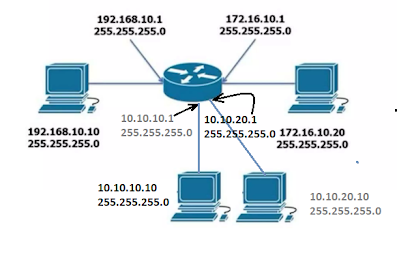
The Network expressed by following this figure:

Comments
Post a Comment
Thanks